
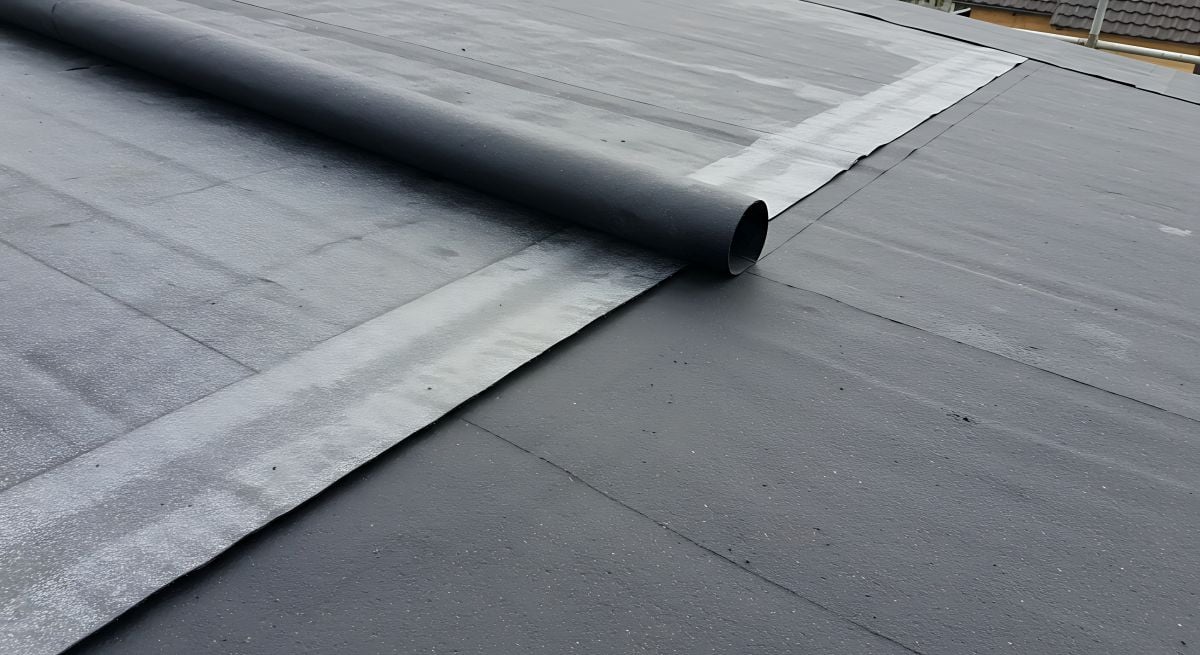
5 Flat Roof Membrane Types Guide for Commercial Roofs
Written By: Justin Puetz | July 1, 2026 | 10 Minute Read

Choosing the wrong roofing membrane for a commercial or low-slope roof is an expensive mistake, and it is one that tends to reveal itself at the worst possible moment. Understanding the differences between flat roof membrane types before a project begins puts building owners in a far stronger position when evaluating contractor proposals and material specifications. Whether you are planning a new commercial build, facing a full reroof, or simply trying to make sense of what is already on your building, this overview of commercial roofing solutions is a useful place to start.
What you’ll learn:
- The five most common flat roof membrane types and how each performs
- Key differences in installation methods, lifespan, and climate suitability
- How to match a membrane type to your building’s specific use and conditions
- What factors drive membrane selection beyond just upfront cost
- How to evaluate contractor recommendations with confidence
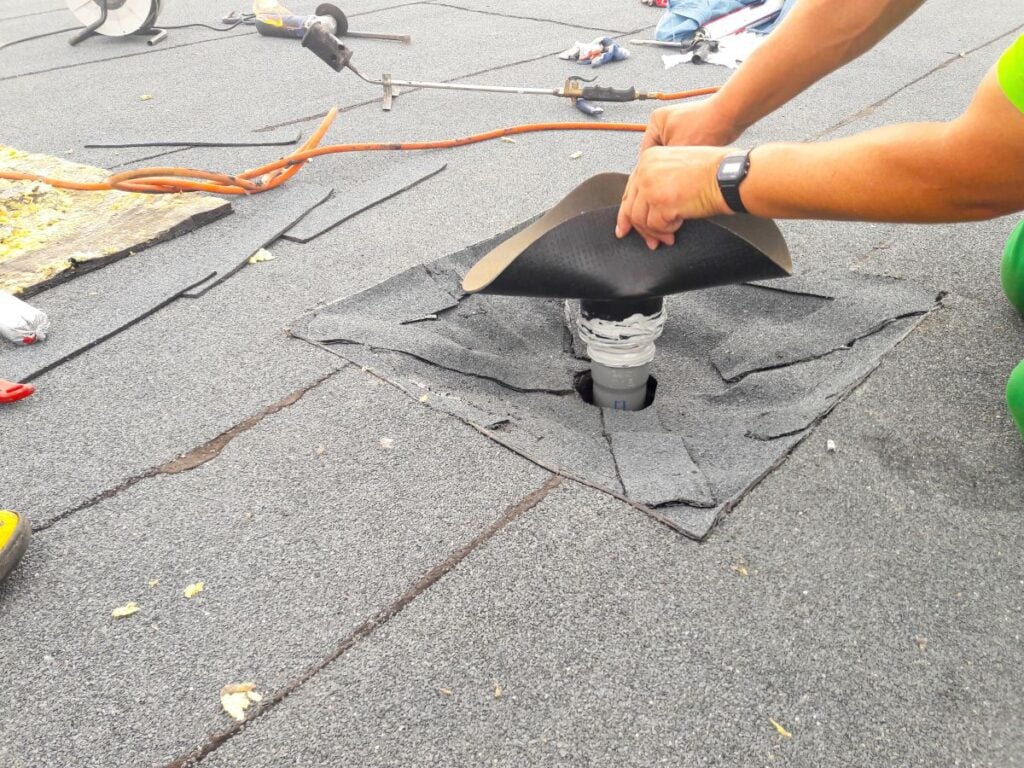
Why Membrane Selection Is the Most Important Decision on a Flat Roof
The membrane is the primary waterproofing layer on any flat or low-slope roof, and its job is to maintain a continuous watertight seal across the entire roof surface for decades. Everything else in the system, the insulation, the drainage components, the flashings, depends on the membrane performing correctly over years of weather exposure. A poor membrane choice does not announce itself immediately. The consequences show up gradually, through seam failures, UV degradation, and moisture infiltration that saturates insulation and eventually reaches the interior. By the time a building owner notices the problem, the damage has already compounded.
Here is why getting the membrane decision right matters from the start:
- Long-term performance over upfront savings: The cheapest membrane installed is rarely the most cost-effective over a 20 to 30 year horizon. Material lifespan, maintenance requirements, and repair costs all factor into the true cost of ownership.
- Climate compatibility is non-negotiable: Not every membrane performs equally in every environment. Temperature extremes, UV intensity, freeze-thaw cycles, and rainfall patterns all influence how a membrane degrades over time.
- Warranty protection depends on the right product: Most manufacturer warranties are voided if an incompatible membrane is used with the wrong substrate, adhesive, or installation method. Selecting the correct system from the start protects that coverage.
- Energy performance is increasingly relevant: Reflective membranes can meaningfully reduce cooling loads on commercial buildings, which translates to real savings on energy costs over the life of the roof.
Membrane selection is not a one-size-fits-all decision. The right choice depends on the building’s use, roof deck type, budget, local climate, and how much foot traffic the roof surface will see.
5 Flat Roof Membrane Types and How They Compare
Each of the five primary flat roof membrane types has a distinct set of strengths, limitations, and ideal applications. Knowing what differentiates them helps you ask better questions and push back when a contractor recommends a product that does not fit your building’s needs. The summary below covers how each membrane is manufactured, how it is installed, and where it tends to perform best.
1. EPDM (Ethylene Propylene Diene Terpolymer)
EPDM is a synthetic rubber membrane classified as a thermoset single-ply roofing material, and it has been a staple of commercial flat roofing for more than 50 years. It is manufactured in large rolls and available in thicknesses of 45, 60, and 90 mil, with 60 mil being the most common commercial specification. Installation costs typically range from $5 to $12 per square foot depending on the attachment method. EPDM can be installed fully adhered with bonding adhesive, mechanically fastened with plates and screws, or ballasted with stone or pavers.
- Lifespan: 25 to 50 years with proper maintenance
- Best for: Cold climates, roofs with ponding water concerns, buildings where long track record matters
- Limitation: Black membrane absorbs heat; seams rely on tape or adhesive rather than heat welding
EPDM is one of the most widely specified membranes for commercial buildings in the upper Midwest and remains a strong baseline option for most building types.
2. TPO (Thermoplastic Polyolefin)
TPO is a thermoplastic single-ply membrane that has seen rapid adoption since the 1990s and now holds roughly 40 percent of the new commercial construction market. Its highly reflective surface makes it a popular choice in climates where cooling loads and energy bills are the primary concern. TPO seams are heat-welded, creating a monolithic bond stronger than adhesive-taped seams when performed correctly. Installation costs typically run $10 to $18 per square foot.
- Lifespan: 15 to 25 years depending on formulation and installation quality
- Best for: Warm climates, energy-conscious buildings, new construction
- Limitation: Shorter track record than EPDM; early formulations had durability issues that vary by manufacturer
TPO has become one of the most commonly specified commercial membranes in the country, and building owners in Austin and surrounding areas often favor it for its reflectivity in a high-UV, high-heat climate where reducing heat absorption and cooling costs can meaningfully offset installation expenses.
3. PVC (Polyvinyl Chloride)
PVC, or polyvinyl chloride, roofing membranes share TPO’s heat-welded seam advantage and have been in use since the 1960s, giving them a longer track record than TPO. PVC is particularly well-suited to buildings where chemical resistance is a priority, including restaurants and industrial facilities where exhaust vents discharge grease or chemicals onto the roof surface. PVC membranes are highly reflective, fire resistant, and highly resistant to puncture. Installation costs average between $7 and $11 per square foot.
- Lifespan: 20 to 30 years
- Best for: Commercial kitchens, industrial facilities, buildings requiring chemical resistance
- Limitation: Higher upfront cost than EPDM or TPO; can become brittle in extreme cold over time
For building owners in Austin and surrounding areas with commercial kitchen applications or specific chemical exposure concerns, PVC is often the most appropriate specification.
4. Modified Bitumen
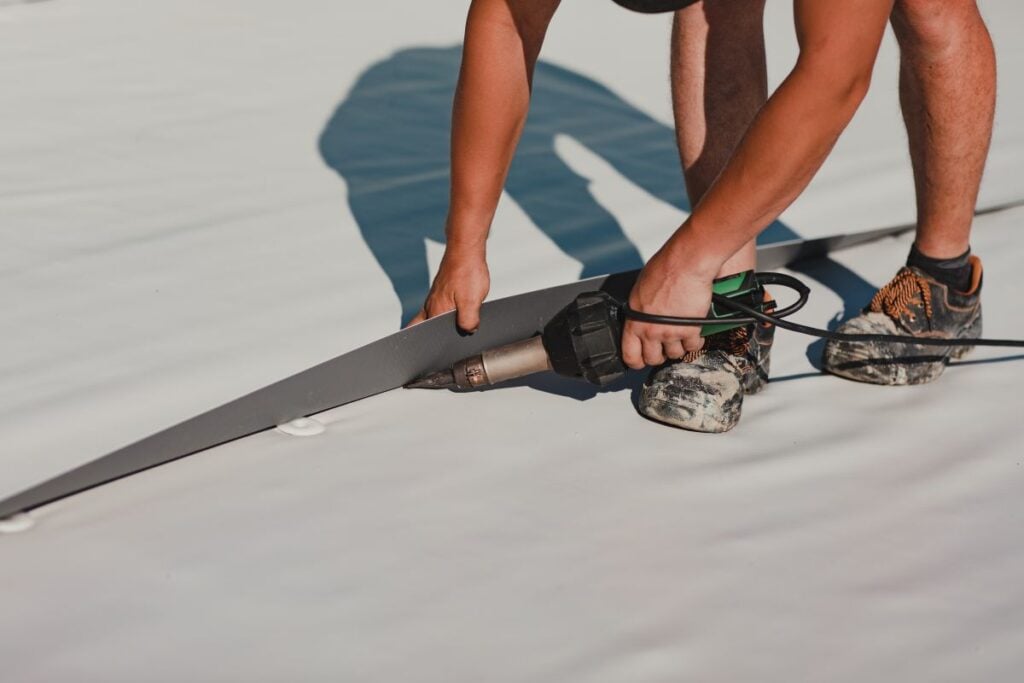
Modified bitumen, commonly referred to as mod bit, is an asphalt-based membrane system used in commercial roofing since the 1970s. It is applied in multiple ply sheets, providing built-in redundancy that single-ply membranes do not offer. Mod bit comes in two primary types: APP (atactic polypropylene), which is torch-applied or hot-mopped, and SBS (styrene-butadiene-styrene), which can be cold-applied or self-adhered. Installed costs typically range from $4 to $8 per square foot.
- Lifespan: 20 to 30 years with regular maintenance
- Best for: Roofs requiring multi-layer redundancy, buildings with high foot traffic, reroof applications over existing built-up roofing
- Limitation: Torch application creates fire risk during installation; heavier and more labor-intensive than single-ply options
Modified bitumen remains a practical choice for roofs that see heavy maintenance traffic from HVAC technicians or other trades, because its layered construction is more forgiving of punctures and surface wear than single-ply membranes.
5. Built-Up Roofing (BUR)
Built-up roofing is the oldest flat roofing system still in widespread commercial use, with a history spanning more than 100 years. It consists of alternating layers of bitumen and reinforcing fabrics, finished with a surface layer of gravel or a reflective cap sheet. BUR systems are fully adhered to the deck and provide excellent redundancy through their multiple-layer construction.
- Lifespan: 20 to 40 years depending on the number of plies and maintenance
- Best for: Large commercial and industrial roofs, roofs with complex geometry, buildings where redundancy is the priority
- Limitation: Heavy, labor-intensive to install, and more difficult to repair precisely than single-ply systems
BUR has largely been supplanted by single-ply systems for new construction, but it remains the correct specification for certain large-scale commercial applications and for reroof projects where the existing BUR system is being reinforced rather than fully replaced.
Understanding how these five systems differ gives you the framework to evaluate any proposal with clarity. Every membrane type has legitimate applications, but only one or two will be the right fit for a given building.
What Drives Membrane Selection Beyond the Membrane Itself
Selecting a membrane type is only the first layer of the decision. Several additional factors influence which product and specification are actually appropriate for your building, and overlooking them is how well-intentioned projects end up with underperforming roofs.
Roof Deck Compatibility
Not every membrane is compatible with every deck type. Steel, concrete, wood, and existing roofing surfaces each have specific requirements for adhesion, fastening, and insulation attachment. A fully adhered TPO system over a concrete deck has different material and labor requirements than the same membrane over a steel deck. Your contractor should specify the complete system, not just the membrane, before any work begins.
Insulation Type and Thickness
The insulation layer beneath the membrane affects the entire thermal and moisture performance of the roof assembly. Polyisocyanurate board is the most common choice for commercial flat roofs, but performance varies depending on the membrane above it and the climate below. In Austin and surrounding areas, where heat management is the primary concern, the insulation needs to be coordinated with a reflective membrane to achieve meaningful energy performance gains.
Attachment Method
Each of the three primary attachment methods carries different implications for wind uplift resistance, long-term membrane performance, and installation cost. Mechanically fastened systems are faster to install but can allow thermal bridging through the fasteners. Fully adhered systems perform better overall but require more labor and precise surface preparation. The attachment method should match the building’s wind exposure zone and the membrane manufacturer’s requirements.
Existing Roof Condition
For reroof projects, the condition of the existing roof assembly significantly influences which membrane systems are viable. Some membranes can be installed directly over an existing single-ply system if the substrate is sound and dry. Others require full tear-off to the deck. Attempting to install over a wet or compromised substrate shortens the new roof’s service life regardless of which membrane is specified.
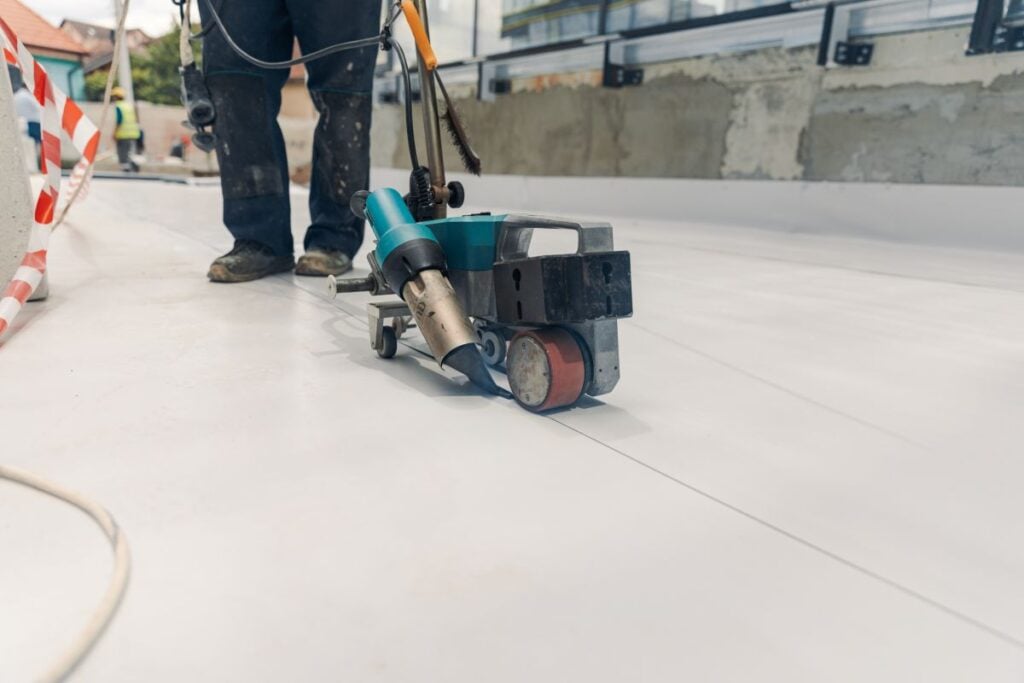
How to Evaluate a Flat Roof Membrane Proposal
When a roofing contractor presents a proposal, the membrane type is typically mentioned prominently, but the details that determine whether the system will actually perform are often buried in the specification or left out entirely. Knowing what to look for protects you from proposals that leave critical decisions unresolved.
| What to ask | Why it matters |
| What is the membrane thickness? | Thicker membranes last longer and resist puncture better; 45 mil is minimum, 60 mil preferred for commercial |
| Which manufacturer is being specified? | Warranty terms, product quality, and installer certification requirements vary significantly |
| What is the attachment method and why? | The method should match the building’s wind zone and deck type, not just be the fastest option |
| Is the insulation included in the spec? | The complete roof system, not just the membrane, determines long-term performance |
| What warranty is being offered? | Distinguish between the material warranty and the workmanship warranty; both matter |
| Is the installer manufacturer-certified? | Certification is required for full warranty coverage on most commercial membrane systems |
For building owners in Austin and surrounding areas evaluating proposals on commercial properties, these questions separate contractors who have specified the right system from those who have defaulted to whatever they install most frequently.
Make the Right Call on Your Commercial Roof
The membrane on your flat roof is not a commodity decision. It is a long-term investment in the performance, energy efficiency, and structural integrity of your building. Getting it right requires matching the product to the building, the climate, and the installation team doing the work. Puetz Construction brings the technical knowledge and licensed expertise to help building owners evaluate their options clearly and specify the system that will perform over the long haul, not just pass inspection on day one. If you are planning a commercial roofing project and want a professional assessment of your options, contact us today and let’s build the right spec together.
Fresh From our Blog